
Costco’s rotisserie chicken is a popular choice for families looking for an affordable, ready-to-eat source of protein. Because so many people buy it regularly, understanding its calories, protein, fat, sodium, and ingredients can help you decide how it fits into your overall eating habits.
Costco rotisserie chicken nutrition is a frequently searched topic because many shoppers want to know its calories, protein, fat, and sodium before adding it to their meal plans. Looking beyond the price helps put those nutrition facts into context.
I bought several Costco rotisserie chickens while preparing this guide and compared the package label with the edible meat after removing the skin and bones. The actual portions matched Costco’s published serving information closely, although most adults would likely eat more than the standard 3-ounce serving in one meal.
The nutrition facts are straightforward, but understanding the serving size and sodium content helps put them into context.
Costco Rotisserie Chicken in Ready-to-Eat Meals:

Back in 2009, Costco set its rotisserie chicken price at $4.99 – then kept it there on purpose, even as ingredient costs climbed year after year. Instead of passing expenses to shoppers, the chain treats the bird as a magnet, drawing people into stores despite losing money on each one. Every year, more than 100 million of these chickens fly off shelves nationwide. That number dwarfs every other ready-to-eat food ever sold through U.S. retailers. Because so many get cooked the same way, week after week, their nutritional profile stays steady from city to city.
You’d be hard pressed to find another takeout option with such predictable numbers behind it.
A typical roasted bird weighs about 3 pounds after cooking, treated beforehand with a special mix of salt solution and spices. Because of that soak, the salt level becomes the biggest factor shaping its overall nutrition facts. The way brining changes sodium totals matters most – especially how those levels shift between parts like breast or thigh. Knowing where salt builds up helps manage intake through regular eating habits. Grasping this pattern forms the real foundation for making sense of Costco’s ready-to-eat chicken on a nutritional level.
Nutrition Facts Per Serving:
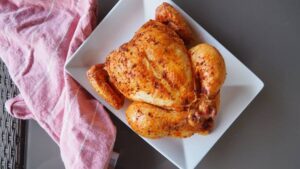
A single portion, according to Costco, means 3 ounces – just 85 grams – of chicken without skin. In real life though, people tend to eat more, usually between five and eight ounces at once. Knowing the official number matters first. Only after adjusting for how much someone actually eats does the nutritional info become meaningful.
- A typical 3 oz piece without skin packs 140 calories – stretch that cut to between 5 and 8 ounces, energy levels climb into the range of 233 up to 373. Portion size shifts what’s on your plate, yet every bite stays close in character
- Every 3 oz delivers 19 grams of protein – among the more affordable for how much you spend and how few calories it brings. Not many ready-to-eat options pack this much fuel without costing more or loading on energy
- Every 3 oz portion without skin packs 7g of fat. That serving holds just 2 g of saturated kind. Less shows up here compared to many cold cuts in similar amounts
- Every 3 oz has 460 mg of sodium. Based on those published values, a 5-ounce serving would contain approximately 767 mg of sodium.
- Zero carbs sit alongside pure protein and fat here, fitting neatly into low-carb or keto eating patterns without compromise
The Hidden Sodium in Costco Rotisserie Chicken:
According to Costco’s published nutrition information, one 3-ounce skinless serving contains approximately 460 mg of sodium. Though chicken itself counts as a natural food, that amount jumps way above what you’d find in basic grilled white meat – there, levels sit near 65 to 75 mg for the same size chunk. The difference? Around roughly 390 mg worth of added salt slips in thanks to how Costco preps its chickens. A soak in salty water gets pushed inside the flesh well before heat ever touches it. From start to finish, that liquid boost shapes both taste and number count.
Soaking the chicken beforehand does have real kitchen benefits. Moisture stays put when spinning under intense heat. Seasoning spreads deeper instead of clinging only to the outside. The bird holds up longer near the warming lamps. Yet this method packs in salt unevenly. That shifts the nutritional profile. Store-bought becomes notably heavier on sodium compared to what you roast yourself.Although it looks similar to homemade roasted chicken, the preparation method results in a different nutrition profile.
1: brining pulls sodium into meat fibers
Inside each raw bird, a mix enters under pressure – salt joins modified food starch, sodium phosphate slips in too, now and then some chicken broth tagged along. This blend targets key spots long before heat touches skin. Pressure pushes the liquid deep, not leaving flavor stuck up top. Through tiny shifts in balance, sodium phosphate sneaks past fiber walls, spreading its presence into inner layers. Salt does more than sit on the outside – it travels where eyes can’t see.
Even after peeling off the skin or washing it, most of the salt stays put. That’s because the sodium works its way deep into the meat during processing – not just sitting on top. Take Costco’s version: without skin, three ounces still pack around 460 milligrams. Compare that to a plain roasted breast made at home, no extra salt tossed in – same portion carries less than 75. The difference hits hard when you see where the flavor really lives.
2: Sodium Levels in Different Chicken Cuts
Most of the salt in a Costco rotisserie chicken isn’t spread evenly. Sodium distribution can vary slightly between different cuts because of differences in muscle composition and how the bird is processed. Sodium levels may vary slightly between cuts depending on processing and moisture retention.
Who knew darker meat could be the quieter choice for lower sodium? Picking thighs instead of breast at Costco might surprise you – less salt per portion sneaks in, along with Thigh meat generally contains more iron and vitamin B12 than breast meat. Juicier too, thanks to how it holds water through cooking. Not what most expect when scanning labels.
3: The Phosphate Additive Question
Found in Costco’s rotisserie chicken, sodium phosphate holds water during cooking while helping keep meat juicy. This additive increases the amount of phosphorus you consume with each bite. People with kidney disease often need to monitor their sodium and phosphorus intake. If you have kidney disease, follow the advice of your healthcare professional.
Most of the phosphorus in Costco’s roasted chicken comes from added sodium phosphate. Added phosphates are generally absorbed more efficiently than the phosphorus naturally found in many foods. This difference may be more relevant for people who have been advised to monitor phosphorus intake. Standard nutrition labels tracking calories miss this detail altogether.
Protein Content: One of the leaner options:
Nineteen grams of complete protein per 3-ounce serving is one reason Costco’s rotisserie chicken is widely used for meal preparation. The protein is complete, meaning it provides all nine essential amino acids. At $4.99 for a bird yielding approximately 2.5 pounds of edible meat (accounting for bone, skin, and cooking loss), Costco’s rotisserie chicken delivers protein at roughly $0.08–$0.10 per gram. Based on current Costco pricing, the protein cost per gram is lower than many prepared chicken products sold by major U.S. retailers.
- Chicken also provides leucine, an amino acid found in high-quality protein approximately 1.5–1.7 g — contributing to the protein quality of the chicken.
- Based on the estimated edible meat protein yield per full bird (skin removed): approximately 70–80 g total across all meat portions
- Calculation: $4.99 ÷ estimated 70–80 g protein = approximately $0.06–$0.08 per gram.
- Based on Costco’s nutrition label (140 calories and 19 g protein), each gram of protein comes with about 7.4 calories.
- Zinc per serving: approximately 1.5–2.0 mg — 14–18% of daily recommended intake from one serving
Fat Profile: Skin-On vs. Skinless:
The fat content in Costco’s rotisserie chicken shifts dramatically depending on whether skin is consumed. Skin-on rotisserie chicken delivers approximately 9–11 g of fat per 3-ounce serving including the skin, with saturated fat rising to approximately 2.5–3 g — meaningfully higher than the 2 g saturated fat in the skinless serving. The skin on a rotisserie chicken concentrates both fat and seasoning compounds, making it the primary driver of both caloric density and sodium in skin-on consumption.
Chicken skin contains both unsaturated and saturated fats — a profile similar to what makes olive oil nutritionally favorable, though the saturated fat co-presence in chicken skin gives chicken skin a different fat profile than olive oil.
1: Thigh vs. Breast Fat Distribution
Costco rotisserie chicken nutrition differs between cuts in ways that matter for different dietary goals. Breast meat (skinless) delivers approximately 3–4g of fat per 3 oz serving with 1 g saturated fat — the leanest option on the bird. Thigh meat (skinless) delivers 7–9 g of fat per 3 oz serving with 2–2.5 g saturated fat, along with Thigh meat naturally contains more iron, zinc, and vitamin B12 than breast meat.
The conventional wisdom of always choosing breast meat for general nutrition goals oversimplifies the nutrition picture. For someone targeting iron, zinc, and B12 specifically — common deficiencies in postmenopausal women and older adults — thigh meat’s denser micronutrient profile makes it the more nutritionally complete choice despite higher fat content.
2: Rendered Fat During Rotisserie Cooking
Rotisserie cooking, where the bird rotates continuously over a heat source, allows some fat to drip away during cooking. The continuous rotation prevents fat from pooling, producing a drier surface than oven roasting and reducing total fat content compared to the raw bird’s starting fat specification.
This means the chicken’s fat content is actually lower than equivalent raw chicken roasted in a conventional oven, where fat collects in the pan and partially re-absorbs into the skin and surface meat during the cooking process. The continuous rotation allows some fat to drip away during cooking, although the overall difference compared with other cooking methods is modest.
3: Comparing Skin-On vs. Skinless in Practical Meal Planning
A full Costco rotisserie chicken yields approximately 1.5–1.8 pounds of skin-on meat and around 1.3 pounds of skinless meat across all portions. Removing skin from the entire bird before portioning saves approximately 400–600 total calories and 800–1,200 mg of total sodium across the entire bird — meaningful numbers when planning your weekly portions of family meals.
Removing skin before refrigerating portions — rather than before each individual serving — is the highest-efficiency approach, reducing the temptation to eat skin by removing the decision point at prep time rather than at consumption time.
How Different Diets May Use Rotisserie Chicken:
Costco’s rotisserie chicken can fit into many eating plans, although some health conditions require extra attention to sodium and phosphorus intake. The same food that serves a high-protein athletic diet optimally may require significant modification protocol for someone managing congestive heart failure or stage 3 chronic kidney disease
- Hypertension: People following lower-sodium eating plans may prefer smaller portions and removing the skin.
- Chronic kidney disease: People with kidney disease should follow advice from their healthcare provider because sodium and phosphorus needs vary.
- Diabetes: Since it contains virtually no carbohydrates, it may fit into some lower-carbohydrate eating patterns.
- Heart disease: People following heart-conscious diets may choose skinless portions and watch sodium intake.
- Celiac disease: the rotisserie chicken ingredient label should be reviewed per batch — seasoning blends occasionally vary
| Chicken Option | Serving | Calories | Protein (g) | Total Fat (g) | Sat Fat (g) | Sodium (mg) | Cost Est. |
| Costco Rotisserie (skinless) | 3 oz | 140 | 19 | 7 | 2 | 460 | ~$0.28 |
| Costco Rotisserie (skin-on) | 3 oz | 190 | 17 | 11 | 3 | 510 | ~$0.28 |
| Costco Rotisserie Breast (skinless) | 3 oz | 120 | 21 | 3.5 | 1 | 430 | ~$0.28 |
| Costco Rotisserie Thigh (skinless) | 3 oz | 155 | 18 | 9 | 2.5 | 475 | ~$0.28 |
| Home Roasted Chicken (no salt) | 3 oz | 140 | 21 | 6 | 1.5 | 65 | ~$0.40 |
| Grocery Deli Rotisserie (avg) | 3 oz | 150 | 18 | 8 | 2 | 380 | ~$0.55 |
| Grilled Chicken Breast (no salt) | 3 oz | 128 | 26 | 2.7 | 0.8 | 58 | ~$0.35 |
| Poached Chicken Breast | 3 oz | 122 | 24 | 2.5 | 0.7 | 60 | ~$0.30 |
| Canned Chicken (drained) | 3 oz | 90 | 18 | 1.5 | 0.5 | 270 | ~$0.50 |
| Rotisserie Turkey Breast | 3 oz | 120 | 20 | 4 | 1.5 | 540 | ~$0.60 |
| Baked Chicken Thigh (no salt) | 3 oz | 155 | 18 | 9 | 2.5 | 75 | ~$0.25 |
| Sam’s Club Rotisserie Chicken | 3 oz | 150 | 18 | 8 | 2.5 | 450 | ~$0.27 |
Meal Prep With Costco Rotisserie Chicken:
One Costco rotisserie chicken, broken down strategically, yields four to six complete high-protein meal components from a single $4.99 purchase. Its nutrition profile scales favorably across that breakdown: two breast halves yielding approximately 6 oz each, two thighs at approximately 4 oz each, two drumsticks at 3 oz each,.The remaining carcass can also be used to make homemade broth.
The meal prep math works as follows: two people eating 5 oz protein servings per meal get four dinners from one bird. A typical Costco rotisserie chicken provides about 7–8 servings. At $4.99, that works out to roughly $0.60–$0.70 per serving. Few prepared protein options offer a similar combination of price, convenience, and protein content.
1: Bone Broth From the Carcass: A Hidden Nutritional Dividend
After portioning all edible meat, the Costco rotisserie chicken carcass — including spine, rib cage, neck, and wing tips — contains significant residual collagen in the cartilaginous tissues surrounding the joints. Simmering the carcass for 4–6 hours in water with a tablespoon of Some people add apple cider vinegar when making bone broth, although the exact effect on nutrient extraction is unclear.
USDA does not list collagen as a required nutrition label value, but homemade bone broth may contain collagen and small amounts of minerals depending on how it is prepared.
2: Refrigeration, Reheating, and Nutritional Stability
Cooked Costco rotisserie chicken retains most of its nutritional value when stored at or below 40°F for up to four days per USDA food safety guidelines. Beyond that window, Quality gradually declines during extended storage.
Reheating does not meaningfully change its macronutrient content — protein, fat, and sodium remain stable through one reheating cycle.
3: Freezing Portions for Extended Nutritional Access
Costco rotisserie chicken meat, stripped from the bone and frozen in 3–5 oz portions within two hours of purchase, maintains most of its original nutrition profile for up to three months at 0°F. Vacuum sealing before freezing can help reduce freezer burn and preserve quality during storage
If frozen promptly after purchase, portioned chicken can maintain good quality for up to three months, making it easy to keep cooked protein available for future meals with each portioned serving maintaining the full Costco rotisserie chicken nutrition values from the original bird.
How Costco Compares With Other Rotisserie Chickens:
Costco’s rotisserie chicken does not exist in isolation— it operates within a competitive landscape of warehouse and grocery store rotisserie chicken options that vary meaningfully in sodium, price, seasoning profile, and bird weight. Understanding where Costco sits within this competitive set clarifies the trade-offs involved in sourcing decisions.
- Sam’s Club Member’s Mark Rotisserie: 450 mg sodium per 3 oz — marginally lower than Costco, similar protein and calorie profile
- Kroger Simple Truth Rotisserie: 380 mg sodium per 3 oz — lower sodium but $2–3 more expensive and smaller bird
- Walmart Deli Rotisserie: 430mg sodium per 3 oz — comparable sodium, smaller bird averaging 2.2 pounds versus Costco’s 3 pounds
- Whole Foods Market Rotisserie: 240 mg sodium per 3 oz — significantly lower sodium but $13.99+ price point
- Home roasted chicken (unseasoned): 58–75 mg sodium per 3 oz — lowest sodium option with full ingredient control
Using Rotisserie Chicken for Weight Loss: Strategic Application:
The caloric density of this prepared chicken makes it a legitimately effective weight loss protein anchor when portion and pairing decisions are managed deliberately. A 5-ounce skinless serving delivers approximately 233 calories and 32 g of protein — Each 3-ounce serving provides 19 grams of protein for only 140 calories, making it a protein-dense food.
Protein at this density and quality drives satiety through three independent mechanisms: Protein-rich foods are generally more filling than many refined carbohydrate foods, which may help some people feel satisfied for longer. Costco rotisserie chicken nutrition’s combined protein-and-fat profile. High-protein meals may help some people feel full for longer.
1: Building a Sub-500-Calorie Meal Around Costco Rotisserie Chicken
A 5 oz skinless Costco rotisserie chicken breast (233 cal, 32 g protein) paired with 200 g of roasted broccoli (54 cal, 5g protein) and 100g of sweet potato (86 cal, 2 g protein) about 32 grams of protein and meaningful potassium, vitamin C, and beta-carotene — a micronutrient profile that specifically counterbalances the sodium elevation in Costco rotisserie chicken nutrition through potassium-rich vegetables can help balance meals that are higher in sodium.
That potassium-sodium pairing is not incidental. According to the American Heart Association, eating potassium-rich foods may help support healthy sodium balance as part of an overall balanced diet. Pairing rotisserie chicken with potassium-rich vegetables such as broccoli, spinach, or sweet potatoes can help create a more balanced meal.
2: Sodium Management Across a Week of Costco Rotisserie Chicken Consumption
A household eating Costco rotisserie chicken four times per week — each time consuming a 5 oz portion — accumulates approximately 3,068 mg of sodium from the chicken alone across those four meals. For someone on a 1,500 mg daily sodium restriction, this represents two days’ entire sodium budget from chicken across the week.
The management strategy: treat Costco rotisserie chicken nutrition days as designated higher-sodium meals, structuring all other meals that day around low-sodium whole foods — plain grains, unseasoned vegetables, fresh fruit, and water — to keep daily totals within your daily sodium goal without eliminating the chicken entirely.
Understanding the Nutrition Label:
The official Costco rotisserie chicken nutrition information is printed on the packaging label of each bird and is additionally available on Costco’s website in the product detail section. The panel uses a 3-ounce skinless serving as the reference unit — a portioning standard that systematically underestimates most adults’ actual consumption.
The label lists calories, total fat, saturated fat, trans fat (0 g), cholesterol, sodium, total carbohydrates (0 g), dietary fiber (0 g), total sugars (0 g ), protein, and percent daily values for vitamin D, calcium, iron, and potassium. The vitamin D value — approximately 2% DC per serving — reflects the limited vitamin D content of commercially raised chickens. Chicken is not a significant source of vitamin D.
1: Meal Planning for Children and Families
Family meal planning around this rotisserie chicken requires age-adjusted portion awareness that the standard adult serving size does not address. Children’s protein needs are lower than adults’, so smaller portions are usually appropriate. A 2–3 oz portion of Costco rotisserie chicken delivers 12–19 g — potentially the entire daily protein requirement for a young child in a single serving.
2: A Weekly Meal Plan Using Costco Rotisserie Chicken
Buying one Costco rotisserie chicken per week and portioning it strategically at purchase provides enough cooked protein. Strip all meat within 90 minutes of purchase, portion into 4–6 oz sealed containers, refrigerate three days’ worth and freeze the remainder. Label each container with the per-serving sodium content so each household member tracks their daily sodium against their individual target.
Pair every serving with at least 200 g of high-potassium vegetables to counterbalance the sodium load it introduces. Rotate between breast and thigh servings to access the different micronutrient profiles across the week. Use the carcass for bone broth on day two. Applied as a system, Costco rotisserie chicken nutrition becomes not just a convenient protein source but a offers good value that delivers consistent macro-nutrients at minimal cost and preparation time.
How this nutrition information was prepared
Official nutrition values were taken from Costco’s published nutrition information. Food safety recommendations follow USDA guidance. General nutrition information was cross-checked with USDA FoodData Central and NIH resources where appropriate. Portion-size calculations and cost-per-gram estimates were calculated by the author using Costco’s published serving data.
Conclusion
Costco’s rotisserie chicken delivers 19 g of complete protein per 3 oz serving at under $0.10 per gram — it can be a practical option in prepared retail protein. Remove the skin, pair with high-potassium vegetables, limit to one portion per high-sodium day, and freeze extras within two hours. Applied strategically, this $4.99 bird can be part of a balanced weekly meal plan.
FAQ’s
Q1: How much sodium is in Costco rotisserie chicken per serving?
One 3-ounce skinless serving contains 460 mg of sodium from brining and seasoning compounds.
Q2: Is Costco rotisserie chicken nutrition suitable for a low-carb diet?
Yes — it contains zero carbohydrates in all skin-on and skinless preparations across every part of the bird.
Q3: How many calories are in a full Costco rotisserie chicken?
A full 3-pound bird yields approximately 900–1,200 total calories of edible meat with skin removed.
Q4: Does removing the skin significantly change Costco rotisserie chicken nutrition?
Yes — removing skin reduces fat by 35–50% per serving but does not meaningfully lower the sodium.
Q5: How long does Costco rotisserie chicken stay safe to eat?
According to USDA Food Safety guidelines, cooked chicken stored at or below 40°F is generally safe for up to four days.
Summary
Costco’s rotisserie chicken is one of the most cost-effective prepared protein options in US retail — delivering 19 g protein, meaningful B12 and zinc, at 140 calories and $4.99 per full bird. The defining variable is 460 mg sodium per 3 oz serving from the brining process. Managing Costco rotisserie chicken nutrition through strategic portioning, skin removal, potassium-rich pairings, and sodium-aware meal structuring into a practical protein option.
References
- USDA FoodData Central
- USDA Food Safety and Inspection Service
- Costco Nutrition Facts
- NIH Office of Dietary Supplements
- American Heart Association Sodium Recommendations